When code meets conversion: a Full Stack Programmer who builds momentum
In today’s crowded digital marketplace, a Full Stack Programmer from Full Blown Web Designs does more than deliver pages that look good. They architect systems that move visitors through your funnel, accelerate loading times, and climb search rankings—creating measurable ROI from day one. This is not just about writing clean code; it’s about engineering growth at scale, with a design-first mindset and a data-driven approach to SEO. If your goals include custom web design, elite programming and integrations, and a technicalSEO edge that locals notice, you’ve landed in the right place. At Full Blown Web Designs, we position our engineering talent as a trusted growth partner. We combine front-end excellence, robust back-end discipline, and a keen understanding of how performance, security, and accessibility interact with user intent. For Full Stack Programmer engagements, we don’t just ship features—we ship velocity. Our work spans modern API-driven architectures, rapid integration with CRMs and marketing platforms, and optimization loops that translate technical milestones into revenue and ranking improvements. Learn more about our approach at https://www.fbswebdesigns.com.The core value: designing for speed, precision, and measurable outcomes
Speed isn’t a metric you chase; it’s a capability that shapes every decision. A Full Stack Programmer from Full Blown Web Designs begins by aligning the technology stack with your business model. We map user journeys, instrument critical events, and create a performance baseline you can trust. Then we infuse engineering with a design discipline that ensures pages load faster, render beautifully, and convey the right cues to convert visitors into customers. Our style is systematic, not spontaneous: - Design-led development that respects accessibility, responsive behavior, and semantic markup, so search engines understand your content. - Instrumented back-end processes that log meaningful signals for attribution, enabling precise ROI measurement. - A relentless focus on security and stability, because a fast site that breaks under load undermines conversions and trust. - Seamless integrations with your existing tools—CRM, analytics, email automation, and marketing platforms—so your tech stack works as one. As a result, a Full Stack Programmer at Full Blown Web Designs delivers not just a site, but a scalable engine that supports ongoing growth, while your internal team focuses on strategy and customer relationships.What a top-tier Full Stack Programmer delivers
To ensure you attract qualified prospects who will hire Full Blown Web Designs for custom web design, elite programming, and technical SEO, here is a concise view of what our programmers bring to the table:- Custom web design that blends aesthetics with performance, accessibility, and mobile-first principles
- Elite programming and integrations, including API-first architectures and robust data workflows
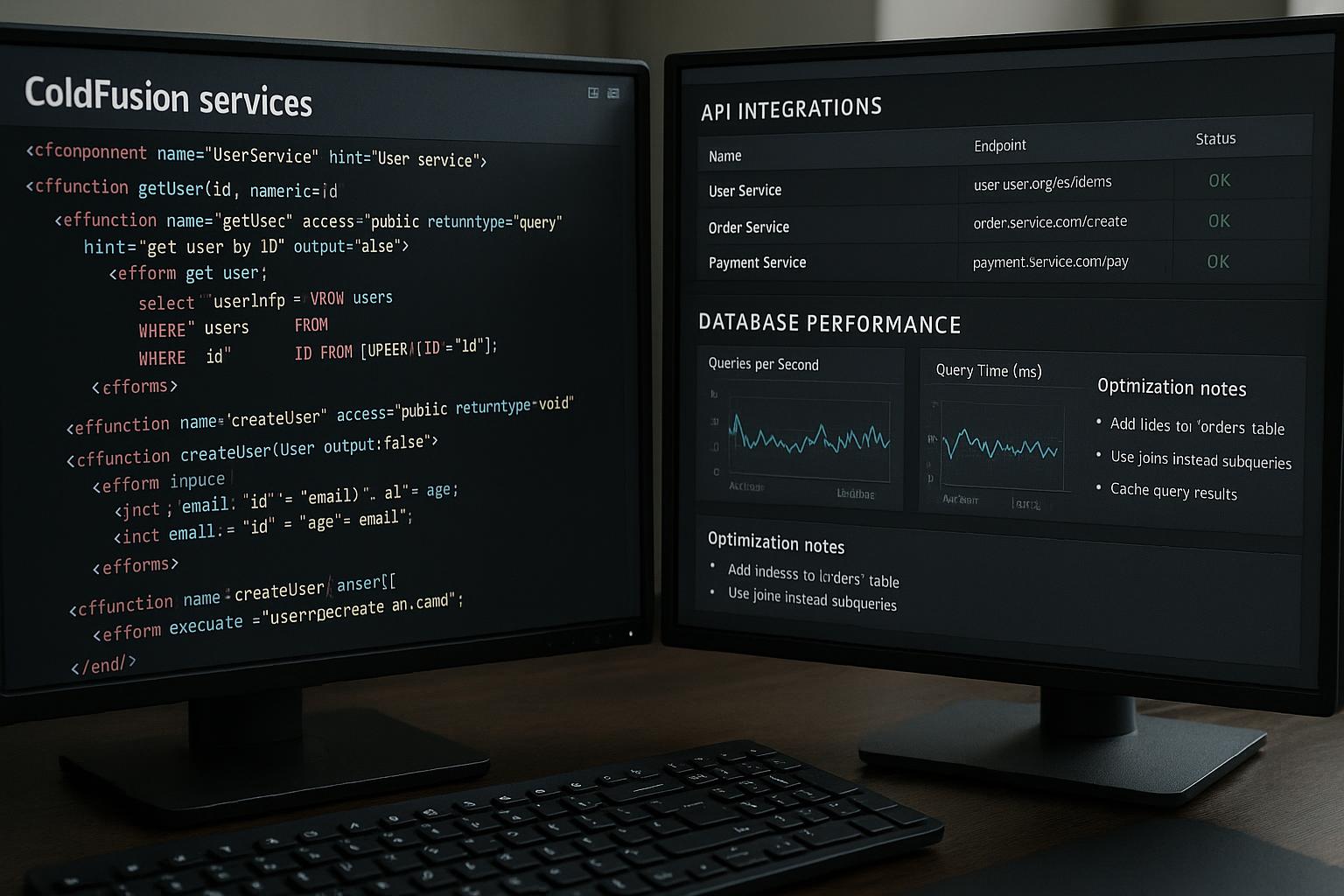
- Elite handling of ColdFusion and database-heavy development, with modernized data access and migration paths
- Technical and local SEO that is integrated into every build, not tacked on at the end
- Strong focus on measurable results: speed, conversions, rankings, and revenue impact
Practical steps you can implement today
Implementation is where strategy becomes value. Below are practical steps any Full Stack Programmer would follow to accelerate ROI for a client with complex back-end needs and ambitious growth targets. This is not theoretical—it’s a concrete playbook you can apply to your next project.- Discovery and baseline: Define business goals, map user journeys, audit existing systems (including ColdFusion components and database layers), and establish a performance baseline (Lighthouse scores, time-to-interactive, first contentful paint, and Core Web Vitals).
- Architecture and data strategy: Decide on the lead architecture (microservices, modular monolith, or API gateway approach). Identify data duplication risks, design data contracts, and map how CRM and marketing tools will synchronize with the site.
- UX and design alignment: Create a design system that prioritizes speed, accessibility, and clarity of calls-to-action. Validate with real users or stakeholders to ensure the interface supports conversion goals.
- Performance engineering: Establish performance budgets, implement server-side rendering or streaming where appropriate, optimize asset delivery, and apply code-splitting and lazy loading for critical paths.
- Code quality and governance: Introduce automated testing, static analysis, and a CI/CD pipeline that preserves performance while enabling rapid iteration across front-end and back-end layers.
- SEO-first development: Build semantic HTML, structured data, and canonicalization strategies from day one. Ensure site architecture, internal linking, and hreflang (for multilingual sites) are in place.
- Security and reliability: Harden authentication flows, protect data at rest and in transit, implement rate limiting, and plan for disaster recovery and backups.
- Tracking and attribution: Instrument events for leads, signups, and conversions. Align analytics with your sales funnel so you can attribute ROI to specific features and optimizations.
- Migration and data integrity: When dealing with ColdFusion or legacy databases, plan careful migrations with rollback paths, preserving data integrity and minimizing downtime.
- Measurement and refinement: Review metrics weekly and monthly. Use insights to prioritize backlog items that move the needle on conversions and revenue, not vanity metrics.
Real-world example: a measurable business case
A mid-market B2B SaaS company approached Full Blown Web Designs with a ColdFusion-backed product site and a fragmented integration landscape spanning an outdated CRM, a marketing automation tool, and a legacy database. They sought to improve qualified leads from paid campaigns, boost on-site conversions, and raise organic rankings for technical and local keywords. What we did: - Re-architected a portion of the backend into a modular API layer to cleanly expose data to both the marketing site and the CRM, enabling faster iteration and safer data migrations. - Implemented a performance-focused front-end strategy with server-side rendering for core pages, critical CSS inlined, and optimized asset delivery. - Integrated technical SEO into the development lifecycle: proper schema, structured data for product and case studies, and a clean site structure with breadcrumb trails and robust internal linking. - Aligned content strategy with conversion goals and local intent, driving more relevant traffic from local searches and industry-specific queries. Measurable outcomes (90-day window): - Leads: +62% qualified leads captured through redesigned inquiry forms and smarter progressive profiling. - Conversions: On-page conversion rate improved from 2.1% to 3.9%, driven by faster load times and clearer CTAs. - Speed: Core Web Vitals improved; first contentful paint dropped from 2.8s to 1.2s on main landing pages; TTI dropped from 6.8s to 2.2s. - Rankings: Technical and local SEO improvements led to top-5 rankings for several target keywords, including competitive long-tail terms specific to the industry. - Revenue impact: Revenue attributed to organic and paid lead generation grew by 28% year-over-year in the quarter following the optimization, with a higher contribution from high-intent pages. This case demonstrates the power of a Full Stack Programmer who can harmonize complex back-end requirements with conversion-focused front-end work and integrated SEO. The result is not just a faster site; it’s a system that produces predictable, measurable growth.How we measure success: a discipline rooted in data
To ensure every engagement with Full Blown Web Designs compounds value, we embed measurement into every layer of the project. We establish KPIs aligned with your business objectives: lead velocity, conversion rate, time-to-value, organic rankings, and revenue per visitor. Then we track and optimize against those KPIs with a cadence that fits your business cycle. Our approach includes: - Regular performance audits and optimization sprints that tie directly to business outcomes. - Conversion-centric experimentation, including A/B tests on layout, messaging, and CTAs. - SEO hygiene checks integrated into sprint planning—ensuring that technical SEO, on-page optimization, and local signals evolve together. - Transparent dashboards and monthly reports that translate technical progress into business language for stakeholders. This method keeps the conversation focused on outcomes rather than features, which is essential when engaging with Full Stack Programmer capabilities that touch multiple disciplines.Why this matters for custom web design and elite programming
Custom web design without depth in engineering and SEO is okay for brand presence; it rarely converts at scale. Elite custom programming and integrations without a performance and SEO backbone can be technically pristine but commercially suboptimal. The value we bring is the integration of these strands into a single strategy: design that sells, engineering that scales, and SEO that earns visibility. For Full Stack Programmer engagements, the cross-disciplinary capability matters: - Custom interfaces and responsive experiences that convert, with clean, maintainable code. - Robust integrations with CRM, marketing automation, call tracking, and analytics to close the loop on marketing spend. - Database-heavy development with thoughtful data modeling, migrations, and security considerations. - Technical and local SEO that gets you found for the right intent, both globally and on a local basis, which is essential for service-area businesses and regional vendors. As you evaluate vendors, ask for examples that demonstrate this integration of performance, SEO, and engineering depth. Our portfolio and case studies reflect the tangible outcomes that matter most: leads, conversions, speed, rankings, and revenue.What to look for when selecting a partner for your stack
If you are evaluating a partner for Full Stack Programmer capabilities, consider these signals: - A track record of measurable ROI across speed, conversions, and visibility, not just pretty pixels or clean code. - Experience with both legacy systems (like ColdFusion) and modern stacks, plus a clear migration path strategy. - A holistic approach to SEO that begins during development, not after launch. - Transparent communication, clear milestones, and a governance model that integrates product, marketing, and IT stakeholders. - A commitment to security, reliability, and accessibility, ensuring long-term trust with users and search engines. We invite you to explore how this philosophy translates into practical results for your business at https://www.fbswebdesigns.com.FAQ
Q: What exactly does a Full Stack Programmer from Full Blown Web Designs do on a typical project?
A: They own the end-to-end technical strategy, combining front-end interface design, back-end data handling, and API integrations. They ensure performance, security, and SEO are built into the architecture from day one, delivering a cohesive product that moves leads through the funnel efficiently.
Q: Do you specialize in ColdFusion and database-heavy development?
A: Yes. We have extensive experience with legacy systems and databases, and we provide migration paths to modern architectures without sacrificing data integrity or uptime. We design data pipelines and API layers that maintain performance while enabling richer integrations with modern tools.
Q: How do you guarantee improvements in speed and SEO?
A: Improvements come from a disciplined process: performance budgets, optimization at the asset and code level, server-side rendering where appropriate, structured data, semantic HTML, and a cohesive internal linking strategy. We measure impact with real metrics (Core Web Vitals, crawl accessibility, keyword rankings, and conversions) and iterate rapidly based on data.
Q: How is ROI measured for these engagements?
A: ROI is tracked through a combination of lead velocity, conversion rate changes, on-site engagement metrics, and revenue impact attributable to specific changes. We align tracking with your CRM and marketing platforms to assign credit to features, experiments, and optimizations.
Q: What is the typical engagement model and timeline?
A: Engagements are scoped in stages with clear milestones: discovery, architecture, implementation, testing, and optimization. Timelines vary by project scope, but we emphasize rapid early wins (90-day benchmarks) followed by iterative improvements that compound value over time.